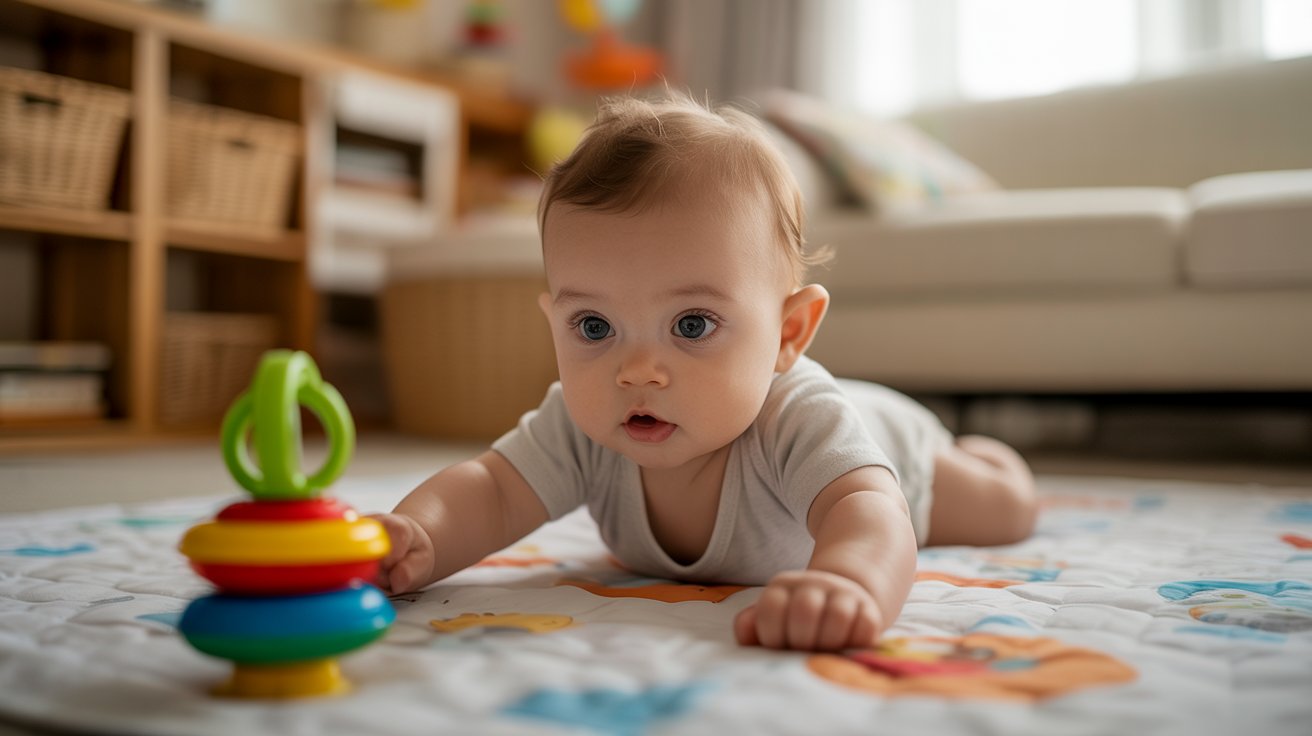
If you're a parent watching your baby wave those tiny fists in the air, you've probably wondered:when do babies start grabbing things?
I've been there, and I know how much comfort it brings to understand what's coming next. When do babies start grabbing things intentionally versus by reflex?
This guide covers everything, from the very first fist curl to full hand control.
You'll get a clear month-by-month timeline, early signs to watch for, the best toys to try, when to check in with your doctor, and simple daily habits that actually help.
I've pulled it all together so you don't have to search anywhere else.
When Do Babies Start Grabbing Things?

Most babies start grabbing things with real intention around 3 to 4 months. Before that, any gripping you see is purely reflex-based.
By 6 months, most babies can grab and hold objects using both hands.
By 9 to 12 months, infant hand development moves into more precise territory, and the famous pincer grasp starts to appear.
Every baby moves at their own speed. A few weeks either way is usually nothing to worry about.
When Do Babies Start Grabbing Things on Purpose?
This is the question most parents are really asking. Intentional grabbing starts between 3 and 4 months, when the brain begins sending deliberate signals to the hands.
Before that point, babies are building the strength, coordination, and visual focus needed to reach for something on purpose. It's a process that happens in layers, not all at once.
Pediatric research in early child development shows that reaching and grasping are key motor milestones closely linked to brain growth and coordination.
Every time your baby tries to grab something, new neural pathways are forming.
Medically reviewed tip:If your baby isn't showing any intentional reaching by 5 months, it's worth bringing up with your pediatrician at the next visit. Early support can make a real difference.
Baby Grabbing Milestones by Age (Month-by-Month Timeline)
Here's a simple look at how baby reaching milestones typically unfold in the first year. The table below gives you a quick overview at a glance.
| Age | Grabbing Development |
| 0–2 months | Reflex grasp only |
| 3–4 months | Starts reaching intentionally |
| 5–6 months | Grasps and holds objects |
| 6–9 months | Improved control, raking motion |
| 9–12 months | Pincer grasp develops |
These baby reaching milestones are an important part of overall infant hand development and fine motor skill growth.
Each stage builds on the one before it, so don't skip tummy time or floor play.
0–2 Months: Reflex Grasp

Your baby's grip at this stage is automatic. Touch their palm and the fingers curl around your finger. This is called the palmar grasp reflex. It's not intentional, but it's the starting point for all fine motor skills a baby will develop later.
3–4 Months: First Intentional Reaching

Around 3 months, something clicks. Your baby starts reaching toward objects on purpose. The aim isn't always accurate, but the effort is real. They might swat at a hanging toy or bat at your hand.
5–6 Months: Stronger Grabbing and Holding

Baby hand coordination gets noticeably better here. Your baby grabs with whole palm and actually holds on. They'll shake things, mouth them, and drop them, then try to grab them again.
6–9 Months: Controlled Grasping

Babies use a raking motion to pull objects closer. Grip strength improves. Passing a toy from one hand to the other becomes possible around this stage.
9–12 Months: Pincer Grasp Develops

The thumb and index finger start working together. This is a major step in infant hand development. Small objects, soft foods, and tiny toys become fascinating targets.
Early Signs Your Baby Will Start Grabbing Soon
A few things show up right before babies start grabbing with purpose.
Tracks moving objects with their eyes for longer stretches. Bats or swats at nearby items. Stares at their hands for long periods. Opens and closes fists frequently throughout the day.
These are all signs that baby hand coordination and visual processing are lining up and getting ready to work as a team.
Why Grabbing Is Important for Baby Development
Grabbing does far more than it looks like.
Fine motor skills. Baby grabbing builds the hand muscles needed later for writing, eating, and dressing independently.
Brain development. Reaching activates multiple brain regions at once, strengthening the connections used for planning and movement.
Hand-eye coordination. The eyes and hands have to sync up to grab something. That coordination carries forward into almost every physical skill a child learns.
Sensory learning. Different shapes, weights, and textures teach your baby about objects before they can use words to describe them.
How to Encourage Your Baby to Start Grabbing
You don't need anything expensive. Small, consistent habits are what actually move the needle.
Use High-Contrast Toys
Babies see contrast before they see full color. Bold black-and-white patterns or bright solid colors hold their attention and give them something worth reaching for.
Practice Tummy Time Daily
This is one of the best things you can do for baby reaching milestones. Tummy time builds the shoulder and arm strength needed for reaching. Start with 3 to 5 minutes a few times a day and build from there.
Offer Easy-to-Hold Objects
Lightweight rattles, soft rings, and silicone teething toys are good choices. If it's too heavy or awkward, babies give up fast.
Place Toys Within Reach
Don't make things too easy or too hard. Put a toy just slightly beyond comfortable reach. That small challenge encourages effort without frustration.
Engage With Both Hands
Offer objects from both sides so your baby builds coordination in both hands. This matters for overall fine motor skills baby will rely on later.
Best Types of Toys for Developing Grabbing Skills
Keep it simple and safe. Here's what works well.
- Soft rattles. Easy to grip, rewarding to shake, good for early grabbing.
- Teething rings. The right size for little fists and interesting to mouth.
- Activity gyms. Hanging toys encourage reaching and batting.
- Stacking cups. Great for grip and release as your baby gets older.
- Fabric books. Different textures keep babies holding on longer.
No sharp edges, no small parts, nothing too heavy.
What If Your Baby Isn't Grabbing Yet?
First, take a breath. There's a wide range of normal. In many cases, small delays resolve naturally with more floor time and interaction.
That said, speak to your pediatrician if you notice any of the following.
No intentional reaching by 4 to 5 months. Baby not bringing hands to mouth by 3 to 4 months. Arms that seem very stiff or unusually floppy.
No attempt to look at or interact with nearby objects. A skill that was there before but seems to have disappeared.
These signs don't mean something is definitely wrong, but they are worth mentioning early. Early intervention, if needed, works best when it starts sooner rather than later.
Common Mistakes Parents Make
A few common habits can slow things down without parents realizing it.
Too much time in bouncers or car seats. Babies need floor time to build the strength that supports reaching.
Doing everything for them. Let your baby try to grab before you step in. The attempt matters, even when they miss.
Toys that are too large or too heavy. If it's hard to hold, your baby will stop trying.
Skipping tummy time. This is the most common one, and it directly slows down baby reaching milestones.
Expert Tips to Support Healthy Development
Talk during play. Narrating what you're doing keeps your baby engaged and works their brain alongside their motor skills.
Get on the floor. Being at eye level makes your baby more motivated to reach out toward you and nearby objects.
Rotate toys. New objects hold attention longer. You don't need more toys, just cycle what's out.
Follow their lead. If your baby is tired or fussy, skip the session. Forced play doesn't build skills.
Try this:Hold a soft toy just within reach and watch what your baby does next. You might be surprised how quickly they respond when the conditions are right.
Conclusion
Watching your baby move from a tight reflex fist to actually grabbing the toy they want is one of those moments that makes you stop and smile.
It builds slowly, stage by stage, from birth through the first year.
I hope this guide gave you a clear picture of what's normal, what to watch for, and what you can do to support your baby right now.
Every baby develops at their own pace, but small daily interactions make a big difference. Try one simple reaching activity today and watch how quickly your baby responds.
If something ever feels off, your pediatrician is always your best first call.
What was the first thing your baby grabbed and wouldn't let go of?
Frequently Asked Questions
At what age do babies start grabbing toys?
Most babies start grabbing toys with intent around 3 to 4 months. By 6 months, most can hold onto an object with a fairly steady grip.
Is it normal if my 4-month-old isn't grabbing yet?
Some babies take a little longer, and that can be completely normal. If there's still no reaching or interest in objects by 5 months, mention it at your next pediatrician visit.
What are signs of healthy infant hand development?
Look for tracking objects with their eyes, batting at toys, bringing hands to their mouth, and eventually passing objects from hand to hand. These all point to healthy progress.
Can too much screen time affect grabbing development?
Passive screen time takes the place of the hands-on play babies need to build fine motor skills. Real objects and active play are what push baby hand coordination forward.
What is the pincer grasp and when does it develop?
The pincer grasp is when your baby uses their thumb and index finger together to pick up small items. It usually appears between 9 and 12 months and is a key milestone in fine motor skills baby development.